Free Epoch Time Converter – Convert Unix Timestamps to Human-Readable Dates
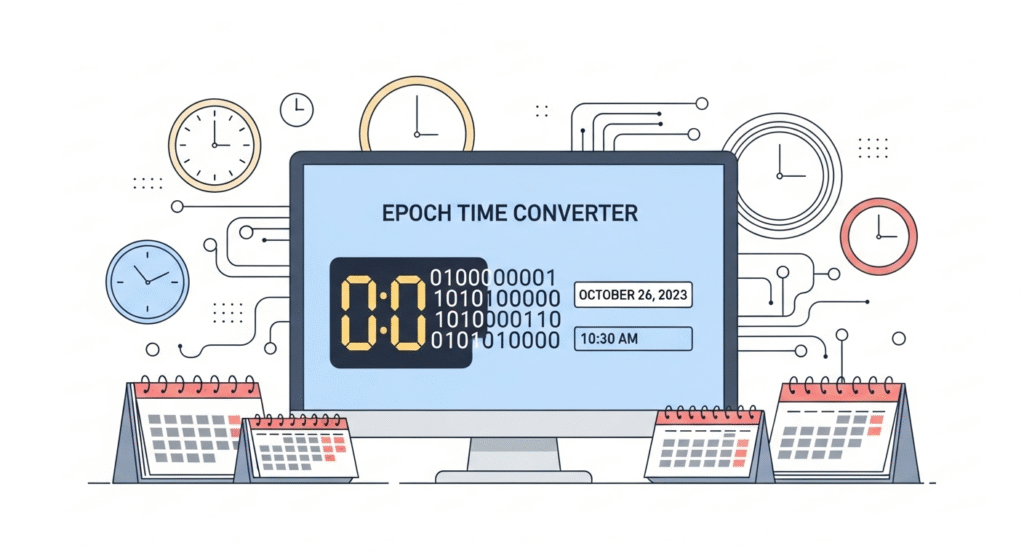
Working with timestamps can be tricky, especially when dealing with logs, servers, or databases. Our Free Epoch Time Converter makes it easy to convert between Unix epoch time (the number of seconds since January 1, 1970, UTC) and human-readable dates. With a single click, you can switch between Epoch to Date and Date to Epoch conversions instantly.
What is Epoch Time?
Epoch time, also known as Unix time or POSIX time, is a system for tracking time in seconds (or milliseconds) since January 1, 1970, 00:00:00 UTC. It is widely used in operating systems, programming languages, and databases because it provides a simple and consistent way to represent dates and times across different platforms.
Why Use an Epoch Time Converter?
Epoch timestamps are useful for computers but hard for humans to interpret. For example, 1755710598 might not mean much at first glance. But when converted, it corresponds to a specific date and time in your local timezone. Our converter helps you:
- Translate epoch numbers into readable dates.
- Convert a given date back into epoch format.
- Work with seconds or milliseconds easily.
- Debug logs, APIs, and databases that use timestamps.
- Save time in development and system administration.
How Does Our Epoch Converter Work?
Simply enter a timestamp or pick a date, and the tool instantly converts it:
- Epoch to Date – Enter a Unix timestamp to see its corresponding date and time.
- Date to Epoch – Enter a date/time to get the epoch timestamp in seconds or milliseconds.
- Current Epoch Time – See the live timestamp updating in real-time.
Example Conversion
If you enter the timestamp 1640995200, the result will be:
January 1, 2022 – 00:00:00 UTC
Similarly, if you input January 1, 2030, the converter will return its Unix epoch equivalent.
How to Use the Epoch Time Converter
- Enter the Unix timestamp in seconds or milliseconds (e.g.,
1700000000). - Select Epoch to Date or Date to Epoch depending on what you need.
- View the result instantly in human-readable format or as an epoch number.
- Copy the output for your development, logging, or database tasks.
Who Uses Epoch Time?
- Developers – Convert timestamps when working with APIs, databases, or code.
- System Administrators – Debug log files with Unix-based timestamps.
- Data Analysts – Convert and compare time-series data.
- Students – Learn how computers track and represent time.
- Everyday Users – Translate confusing epoch numbers into real-world dates.
Benefits of Our Epoch Converter
- Free & Easy – No registration required.
- Instant Results – Conversions happen in real time.
- Supports Seconds & Milliseconds – Flexible for different use cases.
- Two-Way Conversion – Epoch to Date and Date to Epoch in one tool.
- Browser-Based – Works on desktop and mobile without downloads.
Frequently Asked Questions (FAQs)
1. What is the current epoch time?
The current epoch time is the number of seconds that have passed since January 1, 1970, UTC. It updates every second.
2. Why is epoch time used?
Epoch time provides a consistent, timezone-independent way to store and compute dates across platforms.
3. Does this tool support milliseconds?
Yes, you can enter timestamps in either seconds or milliseconds for accurate conversions.
4. Can I convert a future date into epoch time?
Yes, our tool allows you to input any date—past, present, or future—and instantly see its epoch value.
5. Is the Epoch Time Converter free?
Yes, it’s completely free to use with no restrictions.
Conclusion
Epoch time is essential in computing, but it’s not user-friendly. Our Free Epoch Time Converter bridges the gap, making it easy to switch between Unix timestamps and readable dates. Whether you’re a developer, student, or just curious, this tool saves time and simplifies your work.
👉 Try it above now and convert any epoch timestamp into a date instantly!